I am not sure why I feel compelled to write a foreword for a blog as if it was a publication, but here you go. May this be testament of my consistent involvement in academia, good education, criticality, intellectualism and – last but not least – humbleness and modesty.
In this space, I shall present my musings, rant, ramblings and writings on the eve of an impending nuclear armageddon. I will express opinions, share knowledge, stay with the trouble (Haraway, 2016) and for sure ruffle someone’s feathers.
For anyone who knows me, it will be of no surprise that I am extremely proud of my Romanian heritage. While being born and raised in Italy, I have spent considerable time in Romania. I am very used to disclosing sayings, traditions and Romanian folklore with friends from across the world, especially now that I live in the United Kingdom. Keeping this in mind, I would like to expand my reach to anyone interested.
Mǎrțișor is an interest of mine not just because of my culture but also as an Intangible Cultural Heritage (ICH)
Before I go into further detail, to summarise mǎrțișor – it’s a tradition, a Romanian celebration and red-and-white thread which marks the beginning of spring. It symbolises rebirth, renewal, good luck and prosperity.
Definitions and translations
Mǎrțișor is a culture-bound word which is essentially impossible to translate. As Tǎtaru (2014) argues, although attempts at translation of the term have been made in English and French – respectively “March thread / luck charm” and “Talisman de mars” – those are more adaptations rather than equivalent translations which cannot capture the complexity and cultural significance of mǎrțișor.
Mǎrțișor is a Romanian word, its literal meaning is “little march” and is used to refer to both the little object itself, which I will discuss in more detail later and the March 1st festival, that in Romania marks the beginning of spring.
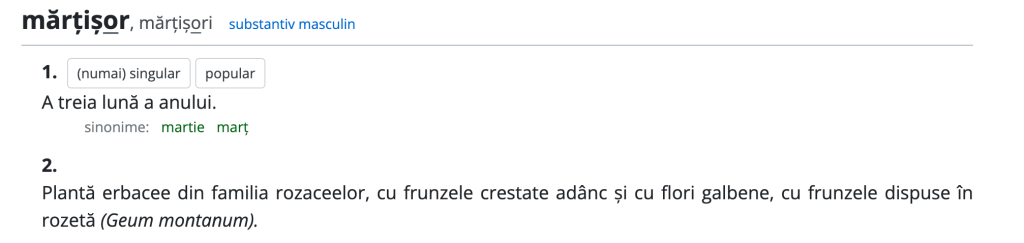
Below the definition of Mǎrțișor from Dex – equivalent of the Cambridge dictionary for Romanian language.
The third month of the year
Geum montanum (plant)
Small decorative object made by an intertwined red and white thread, offered especially to girls and women on March 1st to celebrate the beginning of spring.
Myths and Folklore
Under different names and guises, Mǎrțișor is a tradition common to different countries in the Balkan peninsula, notably Bulgaria and Moldova. Despite similar traditions, mǎrțișor itself is a Romanian tradition which presents specific characteristics.
There are two myths that explain the mǎrțișor thread. According to the first myth, a long time ago, a zmeu (a giant in Romanian folklore) has stolen the sun from the sky and people for three seasons (summer, autumn and winter). A brave young man decides then to face the giant and give the Sun back to the sky, marking the beginning of Spring. In the clash between the giant and the young man, the latter was wounded and shed some blood on the snow from which snowdrops then blossomed. The juxtaposition of colours, red from the blood and white from the snow, is reflected in the trinket – made of white and red intertwined wool threads.
The second myth sees the personification of Spring walking around a meadow when she suddenly sees a blossomed snowdrop. She then decides to make room for it to grow and while moving some twigs and snow around it, she pricks her finger and sheds some blood. In this myth, similarly to the first one, the red from Spring’s blood and the white from the snow are symbolised by the two intertwined strings of mǎrțișor.
Another mythological figure closely associated to mǎrțișor and more generally spring is Baba Dochia – literally, Dochia ‘the Hag’. I will leave the feminist analysis of misogynistic connotation of women (especially elderly) in Romanian folklore for another time. There are a few different stories surrounding Baba Dochia.
I. ‘Trajan and Dochia’. According to this version of the story, Dochia is the beautiful daughter of Decebal, King of Dacians. As Emperor Trajan was conquering part of the Dacian territory, he orders his army to find Dochia. She is however reluctant to marry and hides into the mountains, where helped by Dacian god Zamaloxis, is turned into stone alongside her sheep.
II. Dochia, mother of Dragobete. According to this other version of the story, Dochia is the mother of a young boy Dragobete, who falls in love with a girl and decides to get married to her immediately. Dochia is not happy about his decision and to spite the daughter in-law, she gives her a piece of black wool and tells her to go wash it in the river and come back only when it becomes white. Losing all hope, the girl is suddenly approached by an old man who gives her a red flower and suggests her to put the flower in the water and miraculously, the black wool she was trying to wash turns white. The young girl then pins the flower to her blouse and happily returns to Dochia. The old woman, upon seeing the flower mistakenly thinks spring has come already and, wearing 9 coats, rushes with her sheep to the top of the mountain. On her journey upward, she gets warmer and warmer and gradually sheds each of her coats until, on the 9th of March she has shed all her coats and is wearing just a blouse. Upon reaching the top of the mountain, Dochia then freezes and is somehow turned into stone alongside her sheep. According to this myth, the stone formation at the top of the Bucegi mountains, nicknamed Babele is Dochia with her sheep.
In relation to Baba Dochia, there is another folkloristic myth related to her 9 coats. It is said that the spirit of Baba Dochia haunts earth between the 1st and the 9th days of March, bringing cold weather and snowstorms. In accordance to this tradition, women have to pick one of the first 9 days of march as their baba (hag): if the day they chose turns out to be warm, they will reach old age beautifully and gracefully while if the day turns out to be cold, they will turn bitter and into a hag. Again, this is not the place for me to discuss ageism and misogyny within Romanian folklore, however I might do that at some later point.
Mǎrțișor – the object
Mǎrțișoare can vary greatly for what concerns sizes and charms, but there are two elements that are shared across all regional variations: the intertwined red and white wool threads which are reminiscent of the original myths.
The mǎrțișor itself, made of intertwined red and white wool threads, can be either crafted at home or bought from shops, florists and newsagents. A charm is often attached to the thread and can be either a traditional symbol, which I will expand upon below, or something contemporary. They can be bought around March 1stand it is common practice for boys to buy it as a present to girls they know – family, friends or their lover.
While it is alleged that the tradition is millenary, scouring the Internet for further information was challenging with not much academic literature on the topic. I have come across two antique examples. The first one, dating back to 1872 presents hanging from the white and red string the writing “1 Martie 1872” between a wreath made of laurel and olive branches. The second one, made of silver has a flying swallow engraved, was exhibited at the University of Agronomic Sciences and Veterinary Medicine in Bucharest in 2011.
The charms attached to mǎrțișoare vary although all are related to themes of luck, renewal and spring. Popular charms for mǎrțișoare include three-leaf clovers, horseshoes, chimney sweepers, ladybugs, butterflies, flowers that bloom in spring.
While there are slight regional variations, where girls might craft mǎrțișoare to gift it to boys or girls exchanging a mǎrțișor with each other, the tradition is overall particularly gendered: it is very rare for boys to wear mǎrțișor,or to be invited to craft them, similarly as happens with flowers. A man is unlikely to receive flowers when they graduate or celebrate their birthday.
Queering the mǎrțișor?
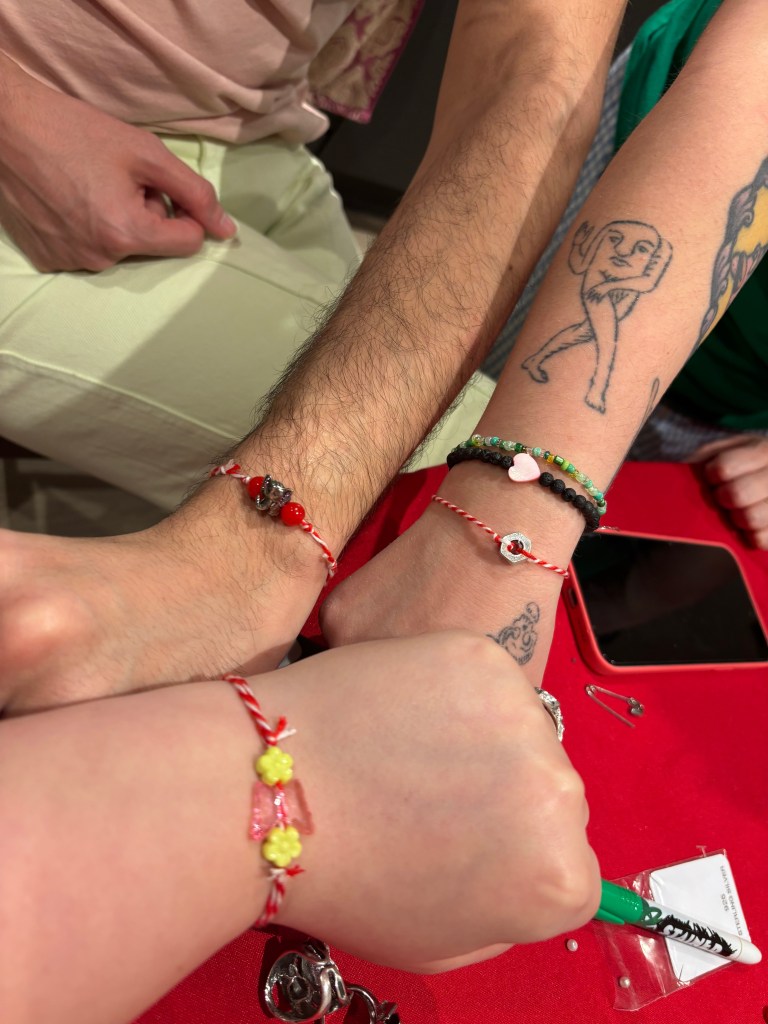
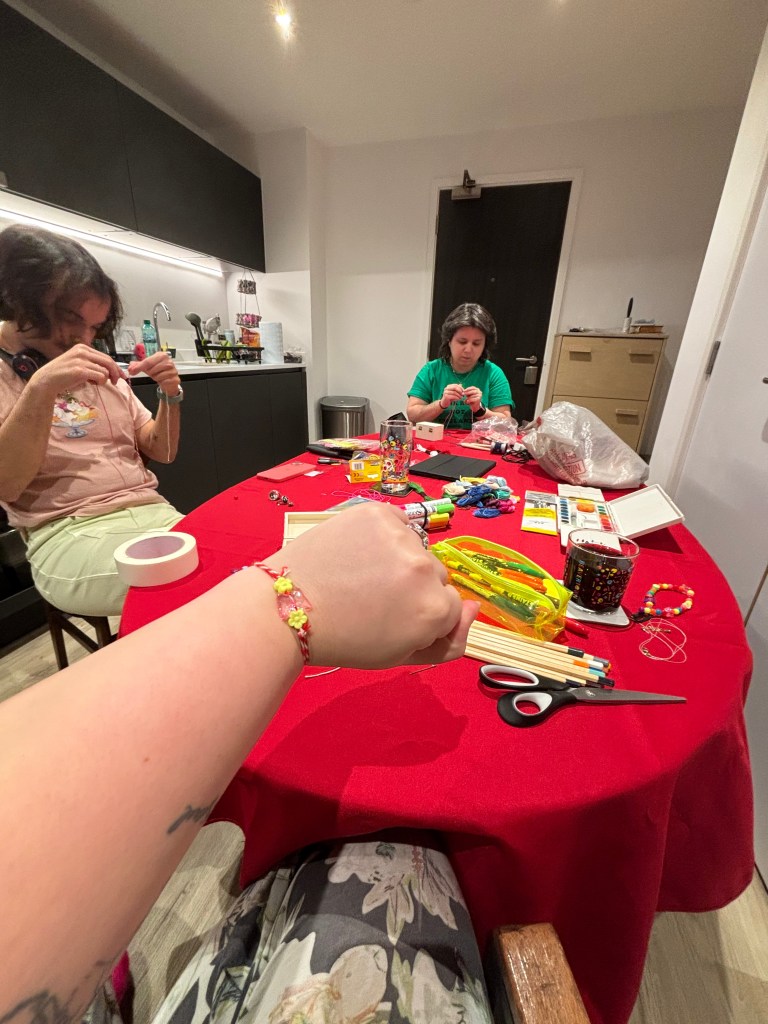
To draw this post to a close, I would like to make some personal considerations about mǎrțișoare and suggest that my friends and I have queered the tradition of mǎrțișor this year. On March 1st, I woke up to a message from my friends Roxana and Nevis who sent me a virtual mǎrțișor depicting a chimney sweeper. We had dinner at their place and later in the evening, we held an arts and crafts session making our own mǎrțișoare. As per usual, it was delightful and giddy to spend time together. However, this time it was extra special: when I was younger, I would always be fascinated by mǎrțișoare, but I would never get one because I am not a girl. This time, however, we made mǎrțișoare for ourselves, bestowing prosperity and luck upon us. Below you will find pictures of us crafting martisoare – Nevis chose a hexagon nut. Roxana a flower and I chose a silver elephant for mine.
I hope the start of spring has been as joyful for you as it has been for me.
Lenzerini, F. (2011). Intangible Cultural Heritage: the Living Culture of Peoples. European Journal of International Law, [online] 22(1), pp.101–120. doi:https://doi.org/10.1093/ejil/chr006.



 Marco Capicotto